Posted: 06/26/2013 12:16 pm EDT | Updated: 06/26/2013 1:03 pm EDT

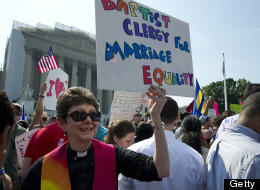
Though the Supreme Court has declared the Defense of Marriage Act unconstitutional and invalidated California's gay marriage ban, marriage remains a complicated and contested issue among religious denominations.
Nationwide, supporters and opponents of same-sex marriage rights announced plans following the rulings Wednesday for prayer meetings and other gatherings, including an event supporting same-sex marriage on Wednesday in the Washington National Cathedral.
“We are ringing our bells at the cathedral to celebrate the extension of federal marriage equality to all the same-sex couples modeling God’s love in lifelong covenants," said the Episcopal church's Rev. Gary Hall. "Our prayers for continued happiness are with them and with all couples who will be joined in matrimony in the years to come."
The United States Conference of Catholic Bishops, which supported DOMA and has been one of the largest national advocates against same-sex marriage, and the Southern Baptist Convention, said it will continue efforts to stop same-sex marriage from being further legalized. (The court ruling on California's Proposition 8 effectively will allow gay marriage in the state, but does change same-sex marriage laws or bans in other states).
"This is a sweeping decision, redefining marriage," said Russell Moore, president of Ethics and Religious Liberty Commission of the Southern Baptist Convention, of the DOMA decision. Of California's Proposition 8 case, Moore said he was concerned because he saw "implications for religious liberty and churches" in addition to his moral views against supporting same-sex marriage.
Leaders of dozens of groups opposed to same-sex marriage, including the National Hispanic Christian Leadership Conference and Southern Evangelical Seminary, also announced plans to "stand together as Christians in defense of marriage."
Most of the nation's biggest religious groups, such as the Roman Catholic Church (68 million members), Southern Baptist Convention (16 million), United Methodist Church (8 million) and the Church of Jesus Christ of Latter-day Saints (6 million) do not perform same-sex marriages, and have drafted resolutions or official church policies defining marriage as between a man and a woman.
Yet, while surveys have shown that people who are against gay marriage most frequently point to religious views to explain their objections, the number of denominations that perform same-sex marriage and blessing ceremonies is growing.
Some smaller Christian denominations and non-Christian groups have started performing same-sex marriages or blessings in the last decade.
The United Church in Christ, which has about a million members, voted in 2005 to allow same-sex marriages. Since individual congregations are largely autonomous, they can choose not to perform same-sex marriages. The Unitarian Universalist Association of Congregations also officially sanctioned same-sex marriage in 1996.
The 1.9-million member Episcopal Church voted last year to start blessing same-sex unions, even though individual priests have been performing same-sex ceremonies for several years. The blessings do not religiously count as marriage, which the church defines as being between opposite sexes. But in places where same-sex marriage is legal, priests can officiate at secular marriage ceremonies. Episcopal bishops are also not required to allow same-sex blessing ceremonies in their dioceses. The Milwaukee Episcopal bishop, for example, said this month that he won't allow same-sex blessings in his diocese.
Similar to the Episcopal church, the Presbyterian Church (USA) does not include same-sex couples in its laws on marriage, but allows ministers to bless same-sex unions. In 2004, after Massachusetts legalized gay marriage but before the push for same-sex marriage legalization picked up steam nationally, the church voted to support state efforts to legalize civil unions. Last July, the church's governing body voted down a proposal to change its definition of marriage to describe a union between "two people" instead of genders.
Views on same-sex marriage among non-Christian religions vary. Among Jews, two of the three major Jewish denominations, Reform and Conservative, allow same-sex marriages. The Reconstructionist movement also allows gay marriages. But each group lets rabbis opt-out of officiating same-sex ceremonies. The Orthodox Union, the major Orthodox Jewish body in the United States, has opposed gay marriage.
Positions also range among Muslims, Hindus and Buddhists. Most mosques do not allow same-sex marriages, and a high-ranking cleric at Egypt's Al-Azhar University, one of Islam's most respected schools, recently declared gay marriage to be against the faith. But organizations such as Muslims for Progressive Values, which has a network of LGBT-friendly mosques throughout the U.S. and Canada, have traveling same-sex marriage officiants. Hinduism does not have an official position on gay marriage, though some Hindus and scholars have pointed to ancient religious texts as condoning homosexuality. Buddhism also has no official stance on same-sex marriage, though "sexual misconduct," is discouraged in the practice's Ten Virtuous Karmas. Some Buddhists interpret that to include homosexuality.
Although policies among religious groups on gay marriage differ widely, recent surveys have shown that members of many religious groups are increasingly supportive of legalization. Pew Research Center statistics released this month showed more than half of Catholics and white non-evangelical Protestants in favor. The Pew report also found 32 percent of black Protestants and 23 percent of white evangelicals to be in support. Each group had increased its share of same-sex marriage supporters over the decade.
Nationwide, supporters and opponents of same-sex marriage rights announced plans following the rulings Wednesday for prayer meetings and other gatherings, including an event supporting same-sex marriage on Wednesday in the Washington National Cathedral.
“We are ringing our bells at the cathedral to celebrate the extension of federal marriage equality to all the same-sex couples modeling God’s love in lifelong covenants," said the Episcopal church's Rev. Gary Hall. "Our prayers for continued happiness are with them and with all couples who will be joined in matrimony in the years to come."
The United States Conference of Catholic Bishops, which supported DOMA and has been one of the largest national advocates against same-sex marriage, and the Southern Baptist Convention, said it will continue efforts to stop same-sex marriage from being further legalized. (The court ruling on California's Proposition 8 effectively will allow gay marriage in the state, but does change same-sex marriage laws or bans in other states).
"This is a sweeping decision, redefining marriage," said Russell Moore, president of Ethics and Religious Liberty Commission of the Southern Baptist Convention, of the DOMA decision. Of California's Proposition 8 case, Moore said he was concerned because he saw "implications for religious liberty and churches" in addition to his moral views against supporting same-sex marriage.
Leaders of dozens of groups opposed to same-sex marriage, including the National Hispanic Christian Leadership Conference and Southern Evangelical Seminary, also announced plans to "stand together as Christians in defense of marriage."
Most of the nation's biggest religious groups, such as the Roman Catholic Church (68 million members), Southern Baptist Convention (16 million), United Methodist Church (8 million) and the Church of Jesus Christ of Latter-day Saints (6 million) do not perform same-sex marriages, and have drafted resolutions or official church policies defining marriage as between a man and a woman.
Yet, while surveys have shown that people who are against gay marriage most frequently point to religious views to explain their objections, the number of denominations that perform same-sex marriage and blessing ceremonies is growing.
Some smaller Christian denominations and non-Christian groups have started performing same-sex marriages or blessings in the last decade.
The United Church in Christ, which has about a million members, voted in 2005 to allow same-sex marriages. Since individual congregations are largely autonomous, they can choose not to perform same-sex marriages. The Unitarian Universalist Association of Congregations also officially sanctioned same-sex marriage in 1996.
The 1.9-million member Episcopal Church voted last year to start blessing same-sex unions, even though individual priests have been performing same-sex ceremonies for several years. The blessings do not religiously count as marriage, which the church defines as being between opposite sexes. But in places where same-sex marriage is legal, priests can officiate at secular marriage ceremonies. Episcopal bishops are also not required to allow same-sex blessing ceremonies in their dioceses. The Milwaukee Episcopal bishop, for example, said this month that he won't allow same-sex blessings in his diocese.
Similar to the Episcopal church, the Presbyterian Church (USA) does not include same-sex couples in its laws on marriage, but allows ministers to bless same-sex unions. In 2004, after Massachusetts legalized gay marriage but before the push for same-sex marriage legalization picked up steam nationally, the church voted to support state efforts to legalize civil unions. Last July, the church's governing body voted down a proposal to change its definition of marriage to describe a union between "two people" instead of genders.
Views on same-sex marriage among non-Christian religions vary. Among Jews, two of the three major Jewish denominations, Reform and Conservative, allow same-sex marriages. The Reconstructionist movement also allows gay marriages. But each group lets rabbis opt-out of officiating same-sex ceremonies. The Orthodox Union, the major Orthodox Jewish body in the United States, has opposed gay marriage.
Positions also range among Muslims, Hindus and Buddhists. Most mosques do not allow same-sex marriages, and a high-ranking cleric at Egypt's Al-Azhar University, one of Islam's most respected schools, recently declared gay marriage to be against the faith. But organizations such as Muslims for Progressive Values, which has a network of LGBT-friendly mosques throughout the U.S. and Canada, have traveling same-sex marriage officiants. Hinduism does not have an official position on gay marriage, though some Hindus and scholars have pointed to ancient religious texts as condoning homosexuality. Buddhism also has no official stance on same-sex marriage, though "sexual misconduct," is discouraged in the practice's Ten Virtuous Karmas. Some Buddhists interpret that to include homosexuality.
Although policies among religious groups on gay marriage differ widely, recent surveys have shown that members of many religious groups are increasingly supportive of legalization. Pew Research Center statistics released this month showed more than half of Catholics and white non-evangelical Protestants in favor. The Pew report also found 32 percent of black Protestants and 23 percent of white evangelicals to be in support. Each group had increased its share of same-sex marriage supporters over the decade.